Introduction
In the heart of Istanbul, where the crossroads of East and West converge, stands the monumental Hagia Sophia. This paragon of architectural prowess is not just a structure of stone and mortar; it’s a chronicle of history, echoing tales of empires, faiths, and artistic mastery. From its inception as a Byzantine cathedral to its rebirth as an Ottoman mosque, Hagia Sophia has been a silent witness to the ebb and flow of civilizations.
The Byzantine Era: Hagia Sophia as a Christian Cathedral
In the year 532 AD, under the auspices of Emperor Justinian I, the construction of Hagia Sophia commenced, forever changing the landscape of Constantinople, now Istanbul. The brainchild of Anthemius of Tralles and Isidore of Miletus, it stood as a testament to the synergy between science and spirituality. Built in a record time of five years, this grand cathedral was a marvel of engineering, boasting a massive dome that soared to the heavens, dominating the city’s skyline. The interior of Hagia Sophia was no less impressive. It was lavishly adorned with intricate mosaics depicting Christian iconography, symbolizing its pivotal role in Eastern Orthodox Christianity.
The Fall of Constantinople and the Dawn of a New Era (1453)
The sands of time brought with them the winds of change. In 1453, Sultan Mohammed II successfully laid siege to Constantinople, marking the end of the Byzantine Empire and heralding a new era under Ottoman rule. Hagia Sophia, the gem of Byzantine architecture, stood at the crux of this transformation, a symbol of the city’s rich legacy.
Upon entering the venerable Hagia Sophia, Sultan Mohammed II performed an act steeped in humility and reverence. He scooped up a handful of earth, sprinkling it over his turbaned head, a gesture that resonated with symbolic significance. This act marked the beginning of a new chapter in the life of this architectural masterpiece.
Transformation into an Ottoman Mosque
The conquest of Constantinople by Sultan Mohammed II was not just a political upheaval; it was the catalyst for a profound transformation of Hagia Sophia. The Sultan, recognizing the significance of this architectural masterpiece, ordered its conversion into a mosque. This act was not merely a change of ownership; it symbolized the shift of an era, from the Byzantine to the Ottoman. The Sultan’s reverence for the structure was evident in his decision to maintain the name Hagia Sophia, which translates to ‘Holy Wisdom’ in Greek, albeit in its Islamic form.
The transformation of Hagia Sophia into a mosque began with the removal of its Christian relics and symbols. This was a delicate task, balancing the need to repurpose the space for Islamic worship while respecting its historical and architectural significance. The Sultan, in his wisdom, preserved certain Christian mosaics and elements, a testament to his respect for the building’s history and the artistic value of these works.
Architectural and Symbolic Modifications
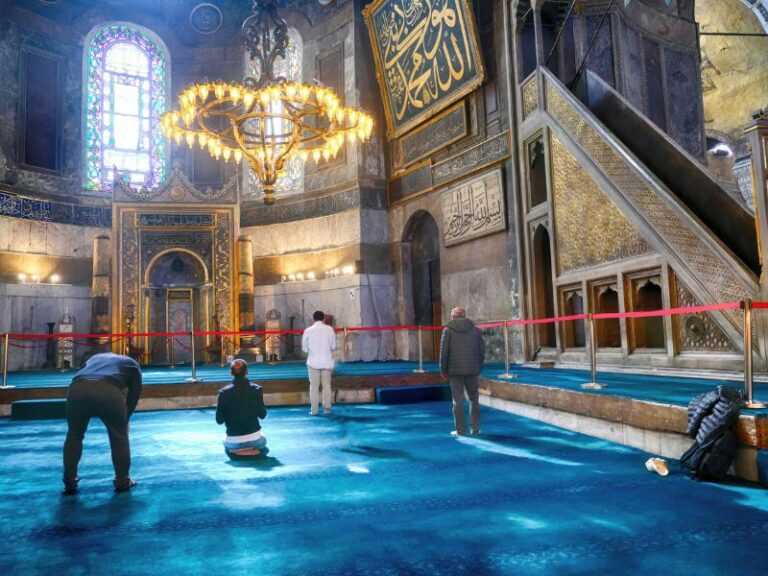
The most visible change in Hagia Sophia’s architecture was the addition of minarets, an essential feature of mosques, symbolizing the Islamic call to prayer. These towering structures were strategically placed, complementing the grandeur of the original design while marking the building’s new identity. Inside, the direction of worship was reoriented to face Mecca, with the installation of a mihrab (prayer niche) and a minbar (pulpit) in the qibla wall.
Interestingly, the architectural transformation of Hagia Sophia also included the tilting of its axis southeastward, aligning it with the Islamic direction of prayer. This architectural ingenuity blended seamlessly with the existing structure, showcasing the harmonious fusion of two distinct religious architectures.
Hagia Sophia’s Influence on Ottoman Architecture
The transformation of Hagia Sophia from a Byzantine cathedral to an Ottoman mosque had a profound impact on the architectural landscape of the Ottoman Empire. It became a blueprint for many mosques that were built thereafter. Hagia Sophia’s massive dome, once a marvel of Byzantine architecture, inspired the design of several Ottoman mosques, integrating its grandeur with Islamic aesthetics. This blend of architectural styles created a new paradigm in the Ottoman architectural realm, symbolizing the empire’s strength, sophistication, and appreciation for art.
The influence of Hagia Sophia extended beyond its architectural features. It stood as a symbol of the Ottoman Empire’s power and its cultural and religious plurality. The mosque became a central point in Istanbul, reflecting the city’s transformation and the Empire’s ability to harmonize different cultural influences.
The 19th Century Restoration by the Fossati Brothers
In the 19th century, Hagia Sophia underwent a significant restoration under the guidance of the Fossati brothers, Gaspare and Giuseppe, who were commissioned by Sultan Abdulmejid. This restoration was not just about structural reinforcement; it was a rediscovery of Hagia Sophia’s hidden treasures. The Fossati brothers uncovered and documented the magnificent Christian mosaics that had been plastered over when the mosque was first converted.
Their work was a delicate balance between restoration and preservation, as they sought to respect the mosque’s Islamic identity while bringing to light its Christian past. The restoration by the Fossati brothers is particularly noteworthy for how it embodied the era’s spirit of enlightenment and cultural respect. It was during this period that Hagia Sophia’s dual identity as both a mosque and a testament to its Christian origins was most vividly illustrated.
Hagia Sophia’s Enduring Legacy and Contemporary Significance
As we navigate through the annals of time, Hagia Sophia’s role has evolved, yet its grandeur and significance remain undiminished. In the modern era, this architectural jewel transcends its religious connotations, emerging as a symbol of cultural and historical confluence. In 1935, under the directive of Mustafa Kemal Atatürk, the founder of modern Turkey, Hagia Sophia was secularized and transformed into a museum. This transition marked a new chapter in its storied history, opening its doors to people of all backgrounds, allowing them to witness its magnificence and the intricate tapestry of its past.
The decision to convert Hagia Sophia into a museum was emblematic of Turkey’s embrace of secularism and cultural inclusivity. It allowed visitors from around the globe to marvel at its architectural beauty and the artistic treasures within, from the awe-inspiring dome to the remnants of Christian and Islamic art. The mosaics, once hidden, now shimmer in the light, narrating stories from a bygone era.
However, the journey of Hagia Sophia continues to evolve. In 2020, it was reconverted into a mosque, a decision that sparked diverse reactions globally. Yet, regardless of its religious status, Hagia Sophia remains a beacon of historical significance and architectural brilliance. It stands as a testament to the rich cultural tapestry of Istanbul and continues to be a cherished UNESCO World Heritage site, attracting millions of visitors each year.
In conclusion, Hagia Sophia, with its domes and minarets reaching towards the sky, continues to be a symbol of the enduring legacy of the empires that once ruled this land. It’s a reminder of humanity’s ability to create beauty and harmony out of diversity, a lesson as relevant today as it was centuries ago.