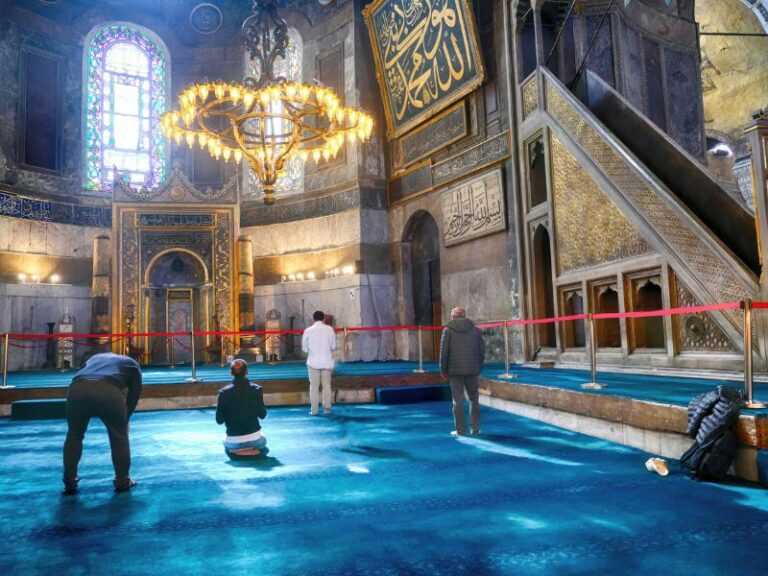
Introduction
In the heart of ancient Constantinople, now Istanbul, stands Hagia Sophia, a monument that has witnessed the ebb and flow of empires and cultures. Its origins, known as Megale Ekklesia, reflect a transformative period in architectural history, spearheaded by Emperor Constantine.
Constantine’s Architectural Revolution
Constantine’s reign marked a decisive shift from traditional pagan temples to the innovative Christian basilicas. The Roman basilica, originally a multifunctional secular building, was repurposed for Christian worship, setting the stage for the first church of Hagia Sophia.
The Birth of Megale Ekklesia
Conceived by Constantine and actualized under Constantius II around 360 AD, as noted in the Chronicon Paschale, the Megale Ekklesia symbolized the intertwining of state and religion. This period saw the emergence of significant religious structures, including Hagia Irene and the Church of the Holy Apostles, paralleling the grandeur of the original Hagia Sophia.
The original Hagia Sophia, christened as the Megale Ecclesia, was not just a marvel of architecture; it was a symbol of the burgeoning Christian faith within the Roman Empire. Consecrated in 360 under Constantius II, as stated in the Chronicon Paschale, this edifice marked a pivotal moment in Constantinople’s religious landscape.
A New Architectural Paradigm
The Megale Ecclesia, later known to be Hagia Sophia, represented a significant departure from traditional temple structures. Its design, rooted in the Roman basilica form, was a monumental shift. These basilicas, typically used for secular purposes ranging from marketplaces to courts of law, were transformed into spaces of Christian worship under Constantine’s vision. The adaptation of this architectural style was a reflection of the intertwining of Church and State.
Megale Ecclesia: The First Hagia Sophia
The construction of the first Hagia Sophia was part of a broader program of imperial construction, aiming to endow the capital with monumental imperial churches. This initiative also included the development of the Church of the Holy Apostles and a significant basilica at the shrine of St. Mocius, located in the west of Constantinople, just outside its fourth-century wall, as per Dark and Özgümuş (2013).
The Architectural Features of Megale Ecclesia
Sparse textual sources offer limited insight into the fourth-century Hagia Sophia, but they do reveal common features such as columns, curtains, and a timber roof, as Taddei (2018) notes. The building’s shape, intriguingly described as ‘circus-like’, might be reminiscent of the ‘U-shaped’ fourth-century Roman basilicas. This architectural resemblance can be drawn with structures like San Marcellino e Pietro, containing St. Helena’s mausoleum, and Sant’Agnese, featuring the mausoleum of Constantina.
Hagia Irene: A Companion to Megale Ecclesia
The significance of Hagia Irene, adjacent to Hagia Sophia, cannot be overstated. Its foundation on the site of a former temple of Aphrodite marked a critical transition from paganism to Christianity. The parallel development of Hagia Irene alongside Hagia Sophia likely reflects a unified architectural and religious strategy under Constantine’s reign.
The foundation of Constantinople in 330 under Emperor Constantine was not merely a political act; it was a monumental display of religious and architectural ambition. The dedication ceremony, a blend of Christian and pagan rituals, set the tone for the city’s future as a melting pot of cultures and beliefs. In the heart of this burgeoning capital, the construction of Hagia Sophia, or the Megale Ecclesia, stood as a testament to this ambition.
The Church of the Holy Apostles and Its Imperial Significance
The Church of the Holy Apostles, another gem in Constantine’s architectural crown, was an imperial church and burial site akin to Westminster Abbey. Its construction, alongside the Megale Ecclesia, signified the emperor’s commitment to creating monumental religious structures in his new capital. This church was not just a place of worship; it was a symbol of the emperor’s divine right and a statement of the Byzantine Empire’s religious fervor.
Saint Helena’s Pilgrimage and Its Impact on Constantinople
Saint Helena’s pilgrimage to Jerusalem and her discovery of Christian relics played a pivotal role in elevating Constantinople’s status as a center of Christian orthodoxy. Her journey, marked by the discovery of the True Cross and other sacred artifacts, brought a flood of religious significance to the city. These relics were not just spiritual symbols; they were political tools that helped establish Constantinople as a new Jerusalem, central to the Christian world.
The Architectural Landscape of Fourth-Century Constantinople
In the fourth century, Constantinople’s architectural landscape was still taking shape. The construction of Hagia Sophia and other churches marked the city’s transformation into a religious hub. These structures, with their grandeur and intricate designs, were a departure from the city’s earlier architectural traditions. They symbolized a new era where religious and state power were intertwined, and Constantinople began to emerge as a beacon of Christian architecture and imperial power.
The Architectural Evolution of Megale Ekklesia
As Constantinople flourished under Emperor Constantine’s rule, so too did its architectural landscape, with the Megale Ekklesia, or the Great Church, emerging as a cornerstone of this transformation. This period marked a renaissance in religious architecture, with the integration of political power and spiritual authority.
Innovative Design of the Megale Ekklesia
The original structure of Hagia Sophia, though sparsely documented, is believed to have had common features of Roman basilicas such as columns, curtains, and a timber roof. The ‘circus-like’ shape of the church, as described in historical texts, suggests an architectural style similar to fourth-century Roman basilicas, incorporating elements like a central nave and possibly a narthex at the entrance.
Religious and Social Hub of Constantinople
The Megale Ekklesia served not only as a religious sanctuary but also as a social hub, reflecting the empire’s commitment to Christianity. The grandeur of its design was a symbol of the empire’s strength and its dedication to the Christian faith, making it a focal point for the community’s religious life.
Archaeological Insights into the Original Structure
Recent archaeological discoveries have offered new insights into the fourth-century structure of the Megale Ekklesia. The unearthed remains, including banded masonry walls and distinct brick patterns, hint at the grand scale and intricate design of the original building, further illuminating its architectural significance in the ancient city.
The Cultural and Religious Tapestry of Fourth-Century Constantinople
As the fourth century progressed, Constantinople’s landscape was increasingly marked by significant religious structures, reflecting the empire’s deepening commitment to Christianity. The original Hagia Sophia, or Megale Ekklesia, stood at the heart of this transformation, embodying the religious and cultural aspirations of the era.
The Megale Ekklesia and Its Religious Role
The Megale Ekklesia was more than an architectural wonder; it was a focal point of the Byzantine religious life. Serving as a central place of worship, it played a crucial role in the spiritual and communal life of Constantinople. The grandeur and sanctity of this structure were symbolic of the empire’s divine mission and its embrace of Christian orthodoxy.
Archaeological Revelations and Historical Insights
Recent archaeological discoveries have shed light on the original structure of the Megale Ekklesia. The unearthed remains, including banded masonry walls and distinct brick patterns, suggest a complex and grandiose design, befitting its status as a centerpiece of Constantinople’s religious architecture. These findings provide a tangible connection to the city’s ancient past, offering a glimpse into the grand scale and intricate design of this early Christian basilica.
Saint Helena’s Enduring Legacy in Constantinople
The influence of Saint Helena, mother of Constantine, on the religious landscape of Constantinople cannot be overstated. Her pilgrimage and the discovery of significant Christian relics not only bolstered the city’s spiritual significance but also solidified its position as a new center of Christian pilgrimage and worship. Constantinople’s emergence as a guardian of sacred relics under her influence marked a new chapter in the city’s history, intertwining its fate with the spread of Christianity across the empire.
The Legacy of the Original Hagia Sophia – From Megale Ekklesia to Byzantine Icon
As we navigate the annals of history, the legacy of the original Hagia Sophia, the Megale Ekklesia, stands as a testament to the architectural and religious evolution of the Byzantine Empire. This final part of our journey explores the enduring impact of this ancient structure and its transformation over centuries.
A Centerpiece of Byzantine Faith and Power
The Megale Ekklesia served as a focal point of the Byzantine Empire’s religious life, embodying the empire’s dedication to the Christian faith. As a pioneering structure in the Christian world, its grandeur and sanctity echoed the empire’s spiritual and political aspirations, deeply influencing the architectural style of subsequent Byzantine churches.
Transformation Through Centuries
Over the centuries, the original structure of the Megale Ekklesia underwent numerous transformations, mirroring the changing dynamics of the Byzantine Empire. Each modification and restoration added layers to its rich history, making it a living chronicle of the empire’s architectural and religious journey.
Archaeological Insights and Future Discoveries
The ongoing archaeological research at the site of Hagia Sophia continues to unveil secrets of its past, offering deeper insights into the original structure’s design and construction. These discoveries not only enrich our understanding of Byzantine architecture but also reinforce Hagia Sophia’s position as an invaluable historical and cultural icon.
Conclusion: The Timeless Appeal of Hagia Sophia
Today, Hagia Sophia stands as a symbol of Constantinople’s, now Istanbul’s, rich and complex history. From its inception as the Megale Ekklesia to its current status, it remains a beacon of historical and architectural significance, attracting scholars, tourists, and devotees alike. Its enduring legacy is a reminder of the profound impact of religious and architectural innovation in shaping the course of history.