Table of Contents
Introduction
The Fall of Constantinople in 1453 was not just the end of the Byzantine Empire—it marked a global turning point. And at the heart of this monumental event stood Hagia Sophia. Once the most revered church in Christendom, it became a symbol of last hope, sacred refuge, and ultimately, the spoils of conquest.
As the Ottomans breached the city’s defenses, thousands fled to Hagia Sophia, seeking sanctuary beneath its great dome. Prayers echoed through its marble halls, but salvation never came. Instead, Hagia Sophia bore witness to the final breath of Byzantium and the first prayer of a new Islamic era.
The Fall of Constantinople was not merely a military event—it was a moment that forever transformed Hagia Sophia and the fate of a continent.
A City Surrounded and a Church Entrusted with Hope

By the 15th century, Constantinople was but a shadow of its former glory. Surrounded by Ottoman lands and isolated from Western help, the city clung to its ancient walls and faith. The defenders—no more than 7,000 strong—stood against Mehmed II’s Ottoman army, which may have exceeded 80,000 men and carried cannons capable of pulverizing even Theodosian walls.
Yet amid despair, belief persisted that Hagia Sophia, protector of the faithful and symbol of divine favor, would shield the city once more. As cannon fire shook the ground, citizens lit candles and whispered prayers beneath the church’s golden dome.
The Eve of Destruction: Hagia Sophia’s Last Mass
On the night of May 28, 1453, Constantinople gathered one final time in Hagia Sophia. Emperor Constantine XI stood beside priests, nobles, and common citizens for what would become the last Christian liturgy in the city. For that brief hour, the centuries-old division between Orthodox and Catholic Christians dissolved in shared fear and devotion.
Tears flowed, embraces were exchanged, and faces lifted to the heavens, hoping for divine intervention. Meanwhile, the Ottoman forces prepared for dawn, their victory imminent.
May 29, 1453: The Fall of Constantinople and the Breach of Hagia Sophia

The Final Assault
Before sunrise, Mehmed II ordered the attack. The walls, battered and breached, could no longer hold. Ottoman troops surged into the city. Panic erupted. Citizens ran through streets consumed by fire and confusion, many making their way toward Hagia Sophia, believing in its protection.
The Storming of the Church
As thousands huddled beneath its dome, some clung to ancient prophecies: that an angel would descend, the gates would close, and Constantinople would be saved. But when Ottoman soldiers broke through the doors of Hagia Sophia, reality drowned myth.
Inside, the faithful continued their prayers. Chaos followed. Some were killed. Others were taken captive. Precious relics were looted. Hagia Sophia—the sacred jewel of Byzantium—was now in Ottoman hands.
From Cathedral to Mosque: Hagia Sophia’s Transformation
Mehmed II’s Entrance and Reverence
Later that same day, Sultan Mehmed II entered Hagia Sophia. Upon witnessing its vast, resplendent interior, he is said to have been moved to awe, offering a prayer of gratitude. But admiration was followed by swift action. He declared it a mosque, and with that, Hagia Sophia’s Christian past was cloaked beneath a new Islamic identity.
Architectural and Religious Conversion
Within days:
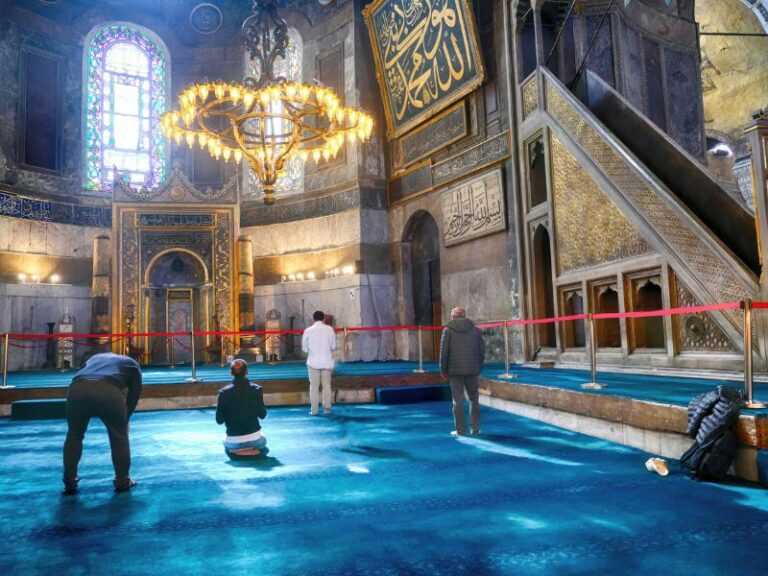
- The Christian altar was dismantled, replaced with a mihrab facing Mecca.
- Icons and mosaics of saints and Christ were covered with plaster or calligraphy.
- A minbar was introduced for sermons, and eventually, minarets rose to dominate the skyline.
Hagia Sophia became the imperial mosque of the Ottoman Empire, shaping not only religious practice but also architectural tradition for centuries to come.
Legacy of the Fall of Constantinople and Hagia Sophia

A World Transformed
The Fall of Constantinople ended more than just an empire—it marked the collapse of the Eastern Roman world and the rise of Ottoman dominance. Hagia Sophia’s transformation from cathedral to mosque signified this shift with visceral clarity.
For Eastern Christians, it was a spiritual calamity. For the Ottomans, a divine victory. For Europe, a shock that would soon propel the Age of Exploration.
Endurance and Rebirth
In 1935, the secular government of Turkey converted Hagia Sophia into a museum, framing it as a monument of shared world heritage. But in 2020, it returned to use as a mosque, reigniting global debates over ownership, legacy, and cultural identity.
Despite its shifting status, Hagia Sophia remains one of the most visited monuments on earth—standing tall through earthquakes, invasions, theological disputes, and political change.
Conclusion
The Fall of Constantinople marked the end of an age and the beginning of another. In those final hours, Hagia Sophia was more than a church—it was the soul of Byzantium, the shelter of a people, and the prize of conquest.
Its dome still watches over Istanbul, unchanged in shape but layered with the memories of empires. From Christian chants to Islamic calls to prayer, from marble altars to golden mihrabs, Hagia Sophia endures—as a witness to tragedy, triumph, and the undying power of belief.